Trade Hounds
- 3.9
- Rating
- 100.00K
- Installs
- Free
- Price

 Analysis by App-foxy
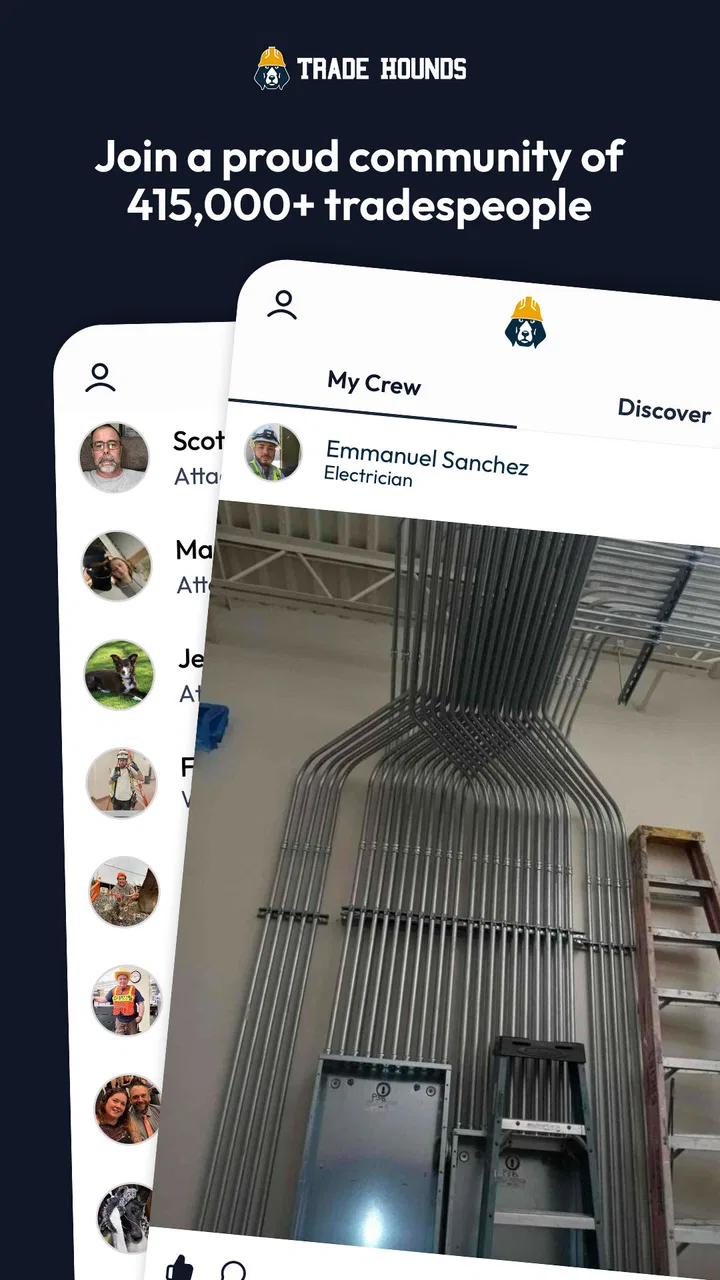
Finding the right people in construction is often harder than finding general social contacts. A question about a tool, a short-term opportunity, a trade-specific problem, or the best way to handle a job usually needs an answer from someone who has actually done that work. Trade Hounds is built around that practical gap: it is a social app focused on construction workers and the conversations that happen around the job.
I approached it less like a general-purpose social network and more like a digital break area where people in the industry can compare experiences, ask for help, and keep an eye on what is happening in their trade. That focus is its biggest strength. You are not entering a broad feed filled with unrelated lifestyle posts; you are looking for a community where construction is the common language.
The app is free, carries a Teen content rating, and comes from Material Management Software, LLC. It has reached over 100 thousand installs, with an average rating of 3.9 from around 400 ratings and nearly 200 written reviews. Those figures suggest a real but still relatively focused community rather than an enormous mainstream network. The current release is version 5.2.0, and the app is available for operating systems version 10 and above.
You May Also Like

 AccuWeather: Weather Radar
AccuWeather Review: A Quick, Clear Forecast for Everyday Decisions
For everyday plans, the best forecast is the one you can understand quickly. AccuWeather makes rain timing, radar, and local conditions easy to act on, with a few trade-offs.

 Hill Climb Racing
Why Hill Climb Racing Still Turns Crashes Into One More Run
A tiny car, a bumpy hill and one more upgrade: Hill Climb Racing keeps resurfacing because its simple chaos makes every near-miss feel personal.

 AliExpress - Shopping App
AliExpress Makes Global Shopping Feel Personal, but Shoppers Bear the Risk
AliExpress turns a global marketplace into a pocket-sized discovery engine. Its reach is useful, its shopping loop compelling, and its trade-offs easy to miss.

 Lords Mobile: Kingdom Wars
Lords Mobile Is a Kingdom-Building Routine, Not a Quick Match
A case-by-case verdict on the building, battles, device demands, and social commitments that make Lords Mobile rewarding for some players and exhausting for others.

 PDF Scanner app - TapScanner
TapScanner Makes Paperwork Easier to Capture, Check, and Share
TapScanner makes scanning with a phone feel less like a rescue operation and more like a dependable step in getting work done. Its capture tools are useful, though not flawless.

 Block Blast!
 Shows How Much a Puzzle Game Can Leave Out
A quiet grid game shows why puzzle players increasingly value instant clarity, repeatable skill and low-pressure play—and where the genre still needs to catch up.
More From Our News Desk
View All News


From a job-site question to a useful answer
I find Trade Hounds most useful when a small question from the workday follows me home: not an emergency, but something I would rather discuss with people who understand construction than search through a general feed. This section looks at how a focused question can become a worthwhile exchange, and why the value depends as much on how I frame it as on who happens to be reading.
Starting with a specific need
The most convincing way to use Trade Hounds is to arrive with a concrete reason. If I opened it simply hoping to be entertained, I would probably judge it against much larger social platforms and find the experience narrower. If I opened it after running into a construction-related question, the purpose would be clearer.
Imagine finishing a shift and realizing that a recurring problem needs a practical solution. Maybe you want opinions from people in the same trade, you are trying to understand how another crew handles a task, or you want to see whether a work-related opportunity is worth pursuing. A focused community can be more useful than searching through a general network, because the replies are more likely to come from people who recognize the tools, routines, and pressures involved.
That does not mean every post will produce an expert answer. Social communities depend on who is active at a given moment, and Trade Hounds is no exception. The app works best when you treat it as a place to gather experience and perspectives, not as a substitute for formal training, a supervisor, or safety guidance.
Before posting, I would make the question easy to answer. Mention the trade or task involved, describe the actual problem, and explain what you have already tried. A vague complaint can disappear in any feed, while a clear question gives other workers something useful to respond to. This is one of the less obvious advantages of a trade-centered network: the audience may understand shorthand that would need a long explanation elsewhere, but clarity still determines whether a discussion becomes valuable.
Moving through the community
The basic flow feels familiar to anyone who has used a social app. You enter a community feed, look through posts, and decide whether to read, react, or contribute. The difference is the subject matter. Instead of filtering a mixed stream of entertainment, family updates, and unrelated news, you are working inside a construction-oriented environment.
That narrower context changes how I would browse. I would not scroll endlessly expecting the same variety found on a general platform. I would use the feed with a purpose: check what other workers are discussing, look for a relevant thread, and save the useful parts mentally or through whatever normal device tools I use outside the app. The value comes from relevance, not volume.
For someone new to the app, the first few sessions should be treated as orientation. Notice which conversations attract detailed replies and which remain mostly casual. Pay attention to whether people explain their reasoning or simply state preferences. That distinction matters when the topic involves tools, work methods, or safety. A confident comment is not automatically a reliable one.
Trade Hounds is also more approachable for people who dislike polished professional networking. Construction workers do not necessarily want to build a formal résumé-style presence just to talk about their work. A community app can feel more natural when the goal is exchanging practical knowledge rather than presenting a carefully edited career profile.
Turning a post into a handoff
The important handoff happens when a personal problem becomes a community conversation. I might start with a question based on something that happened during the day, then receive replies from workers with different levels of experience. At that point, the app is no longer just a place to publish a thought; it becomes a relay between people who may never meet in person.
That relay has a useful trade-off. You can reach a wider range of viewpoints than you might get from one coworker, but you also lose the context that exists on a real crew. A coworker knows the site conditions, the equipment available, and the exact constraints. People replying through the app may understand the trade but not the particular job. I would therefore use responses as input for a decision, not as an instruction to follow blindly.
When the conversation touches employment, the handoff deserves extra care. A social connection is not the same thing as a verified employer or a confirmed opportunity. I would keep personal details limited until I understood who I was dealing with, and I would move sensitive conversations carefully rather than posting private information publicly. This is sensible behavior on any social platform, but it matters especially when work, location, and income are involved.
The same caution applies to disagreements. Construction culture can be direct, and trade discussions may become opinionated quickly. I found the app more useful when reading comments for practical distinctions instead of treating every disagreement as a contest. One worker’s preferred method may depend on local practice, available materials, or the kind of projects they usually handle.
A realistic after-work workflow
Here is the situation in which I can see the app fitting naturally. After a shift, I have a problem that is not urgent enough to interrupt the crew but is specific enough that a generic web search feels inefficient. I open the community, read a few related discussions, and compare how other workers approach it. If the existing conversations do not answer the question, I write a short post with the relevant trade context.
Later, I return to read the replies. The useful outcome is not necessarily one perfect answer. It may be a warning about an approach that creates another problem, a suggestion to ask a supervisor a more precise question, or a list of factors I had overlooked. I then take that information back into my real-world decision-making.
This input-to-outcome flow shows where Trade Hounds is strongest. The app can shorten the distance between a worker’s everyday uncertainty and a group of people who have faced similar situations. It is especially helpful when the question is practical, experience-based, and open to several reasonable answers.
It is less suitable when the answer must be immediate, official, or tailored to a specific site. If a task involves a serious safety risk, I would not wait for social replies. If I need a formal job application process, I would use a dedicated employment service. If I need a private conversation with one known colleague, a direct messaging tool may be simpler.
What the result looks like
A successful session should leave me with something I can use: a clearer question, a better sense of common practice, a new contact, or a more informed view of a work-related choice. That is a modest result, but it is also realistic. The app is not valuable because every visit produces a dramatic opportunity. It is valuable when the community helps turn scattered experience into usable context.
The construction focus gives those outcomes a stronger identity than a general social feed can provide. A broad platform might contain construction groups, but I would have to find them, judge their activity, and filter out unrelated material. Here, the central subject is already established. That saves effort for users who want industry conversation rather than a social network that happens to include it.
Compared with a general messaging app, Trade Hounds is better for discovering people outside my immediate circle. Compared with a professional networking service, it feels more grounded in day-to-day trade life and less dependent on formal career presentation. Compared with a search engine, it can provide lived experience and follow-up discussion instead of isolated pages.
Those comparisons also show the limits. A general platform may have a much larger audience, faster replies, and stronger tools for staying in touch with friends. A professional service may be better for structured recruiting and employment records. A search engine is usually quicker for established technical references. Trade Hounds sits between these options: more focused than a general network, more conversational than a reference source, and less formal than a career platform.
Small habits that improve the experience
I would use a few simple habits to get more from the app. First, I would read before posting. This avoids asking a question that has already been discussed and helps me match the community’s level of detail. It also reveals whether a topic tends to attract thoughtful answers or repetitive arguments.
Second, I would separate experience from authority. A person describing what worked on one project is offering useful evidence, but not necessarily a universal rule. For tools and methods, I would compare several replies and look for explanations that mention conditions, limitations, and trade-offs.
Third, I would write posts so they remain useful after the original moment has passed. Including the type of task, the problem encountered, and the kind of answer needed makes the discussion easier for later readers to understand. This turns a quick social update into a small piece of shared trade knowledge.
Fourth, I would avoid making the app my only professional resource. The best workflow is often a handoff: use the community to collect perspectives, verify important details with qualified people or official guidance, and then make the decision in the appropriate real-world setting. That approach preserves the app’s usefulness without asking it to do a job it was not designed to do.
Where the flow breaks
The first break is community activity. A focused network can be wonderfully relevant, but it cannot guarantee that the right person is online when I need an answer. A smaller audience may also mean that some trades, regions, or specialties feel more represented than others. If my question is highly specialized, I may receive limited discussion and need another source.
The second break is verification. Social replies can be practical and honest while still being incomplete. Construction decisions often depend on regulations, site conditions, equipment, training, and employer procedures. I would never use a popular comment as the final word on a safety-critical task.
The third break is privacy. The more specific a work story becomes, the easier it may be to reveal a company, location, client, or coworker unintentionally. I would remove identifying details from posts and think twice before sharing photographs or employment information. The ability to connect with industry peers is useful, but it should not come at the cost of exposing someone else’s private situation.
The fourth break is expectation. Trade Hounds can support discovery and conversation, but it should not be judged as though it were a full project-management system, a formal learning platform, or a guaranteed recruitment channel. Someone looking for schedules, document control, structured courses, or dependable emergency communication should choose a tool designed for that purpose.
Who should install it
I would recommend Trade Hounds to construction workers who want a focused place to compare experiences, ask trade-related questions, and see how other people in the industry think about work. It also makes sense for someone entering construction who wants to become familiar with the language and recurring concerns of the field, provided they keep a critical eye and continue learning through proper supervision.
I would be more cautious about recommending it to someone who wants a polished professional profile, guaranteed employment leads, or a private team workspace. Those needs point toward different tools. I would also tell users who dislike public discussion or who need instant answers to set realistic expectations before relying on it.
My overall impression is positive because the app has a clear purpose and follows a useful real-world path: bring in a work question, place it in front of a relevant community, collect perspectives, and carry the result back to the job. The experience is not perfect, and the social format means that activity, accuracy, and privacy require personal judgment. Still, the construction-specific focus gives it an identity that general networks often lack.
As a free social app, it is easy to try without turning the decision into a major commitment. I would install it when I wanted industry conversation rather than another general feed, then judge its value by the quality of the discussions relevant to my trade. For the right user, the real benefit is not endless scrolling but a faster handoff from everyday job-site uncertainty to informed human experience.
FAQs for Trade Hounds
01What is Trade Hounds, and who is the app designed for?
Trade Hounds is a social and professional networking app created primarily for skilled tradespeople, including electricians, plumbers, welders, carpenters, mechanics, and construction workers. It provides a space to share jobsite experiences, ask questions, discover industry-related content, connect with other professionals, and explore career opportunities. The community-focused design makes it more relevant to people working in the trades than to general social-media users.
02Can Trade Hounds help me find jobs or advance my career?
Yes, Trade Hounds can be useful for discovering employment opportunities and building professional connections, although results may depend on your location, trade, experience, and how active employers are in your area. Users may encounter job listings, recruiting content, and discussions about companies or projects. It should complement, rather than completely replace, traditional job boards, referrals, union resources, and direct applications.
03Do I need professional trade experience to use Trade Hounds?
You do not necessarily need years of experience to join Trade Hounds. Apprentices, students, people changing careers, and experienced workers can all benefit from the discussions and shared knowledge. However, much of the content is aimed at people familiar with hands-on work and jobsite culture. Beginners should evaluate advice carefully, especially when it involves tools, electrical systems, machinery, heights, or other potentially dangerous tasks.
04Is Trade Hounds free to download and use?
Trade Hounds is generally available as a free mobile app, allowing users to create an account, browse community content, participate in discussions, and interact with other members. Availability of specific features, promotions, recruiting tools, or optional services may change over time. Before downloading, check the current Google Play Store or Apple App Store listing for pricing, in-app purchases, supported devices, and the latest subscription or account information.
05Is Trade Hounds safe and private to use?
Trade Hounds includes community and networking features, so users should treat their profile and posts as potentially visible to other members. Avoid publishing sensitive information such as personal phone numbers, home addresses, employer credentials, private jobsite details, or identifiable images of coworkers without permission. Review the app’s privacy policy and reporting tools, use a strong password, and be cautious when responding to recruiters or meeting online contacts in person.
Pros
- Built-in messaging helps workers connect directly with potential employers.
- Job listings are focused on skilled trades rather than general employment.
- Profiles can showcase trade experience
- skills
- and professional interests.
- Community posts make it easy to discover advice and industry conversations.
- Useful for finding local opportunities within the construction and trade sectors.
Cons
- The number of listings may vary considerably by location and trade.
- Some features depend on having an active
- complete professional profile.
- Not all employers may provide detailed pay or schedule information upfront.
- The community feed can include promotional content alongside useful discussions.
- Users may need to verify employers and job details before accepting an offer.

Trade Hounds
Gallery